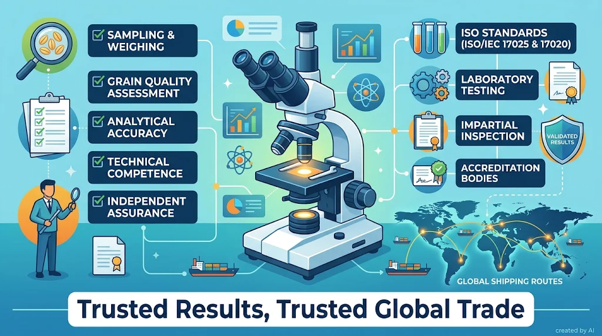


Global agricultural trade relies on trust. When grain and animal feedstuffs move across borders, buyers and sellers depend on accurate inspection, sampling, weighing, and laboratory testing to determine commodity quality, quantity, and condition. Executed consistently, these conformity assessment activities underpin international contracts, prevent trade disputes, and keep vital food and feed supply chains moving efficiently.
Representing over 1,900 member companies across 100 countries, the Grain and Feed Trade Association (Gafta) sets the contractual and technical framework for approximately 80% of all grain traded internationally. Gafta’s Approved Registers establish rigorous sector-specific rules, methods, and codes of practice for Approved Superintendents and Approved Analysts.
International accreditation provides an independent layer of assurance that complements Gafta’s sector expertise:
Those Gafta Approved members who do not hold ISO accreditation are independently assessed against Gafta’s own Standards for Superintendents or Analysis & Testing as an alternative option for those for whom accreditation is not viable.
Together, ISO standards and Gafta’s sector-specific rules ensure that a certificate issued in Bangkok, Buenos Aires, or Brussels carries the exact same technical weight and credibility.
For the 2026/27 marketing year, forecasts from the International Grains Council (IGC) and FAO estimate global grain and cereal production at roughly 2.41 to 2.43 billion tonnes (and nearly 2.98 billion tonnes for total cereals)—the second-largest harvest on record. Moving these massive volumes through a global landscape marked by geopolitical volatility, regional conflicts, and shipping bottlenecks requires resilient quality infrastructure.
By pairing accredited oversight with Gafta’s Approved Registers and active engagement in international bodies—including the International Maritime Organization (IMO), Codex Alimentarius, and ISO technical committees—science-based conformity assessment actively attempts to remove non-tariff barriers. Recognised under the Global ACI Multilateral Recognition Arrangement (MRA), accredited results help prevent trade friction and stabilise supply chains during market shocks.
To deepen this alignment, Gafta and Global Accreditation Cooperation Incorporated (Global ACI) have officially signed a renewed Memorandum of Understanding (MoU). As an active Global ACI stakeholder, Gafta brings practical agricultural trade perspectives directly into international accreditation discussions, supported by Global ACI Technical Committee 2 Chair Paul Matera serving as liaison to Gafta.
Key joint initiatives currently underway for members and accreditation bodies include:
Through ongoing collaboration, shared technical guidance, and mutual recognition, Gafta and Global ACI are ensuring that trusted results continue to power trusted global trade for decades to come.